|
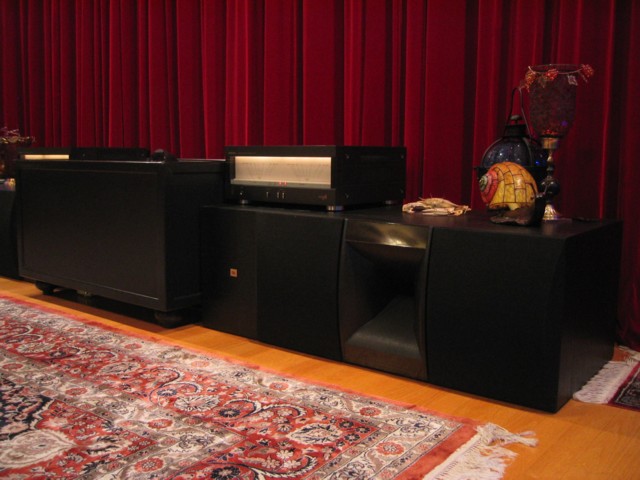
This is my collection of JBL SVA series speakers. I have two pairs, one pair of SVA-1800's and one pair of SVA-2100's and I like the design for a number of reasons as described below. Specifications & Design
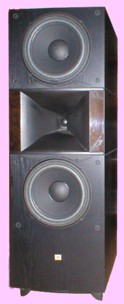
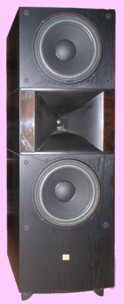
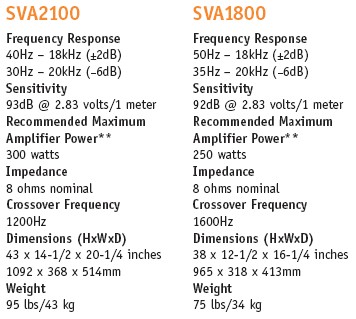
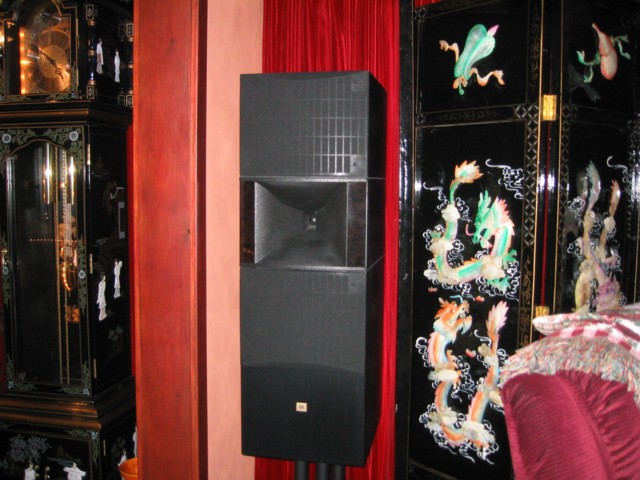
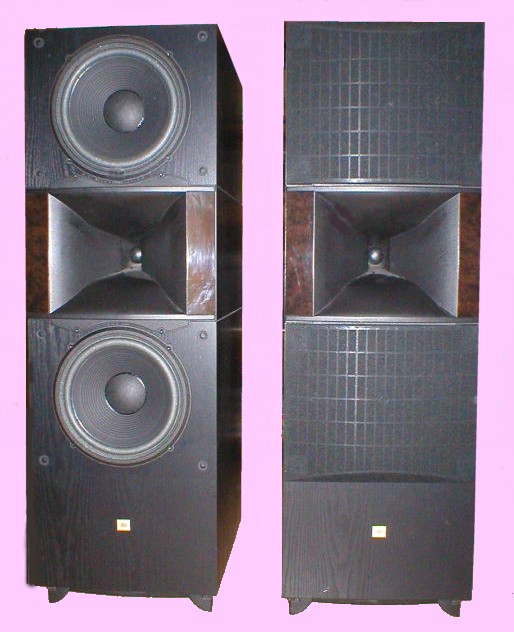
As you can see, these are big heavy speakers and they have a hell of a punch to the sound with the 1800's having a pair of parallel 8 inch bass/mid drivers and the 2100's a pair of 10 inch bass/mid drivers in a bass reflex enclosure with the ports at the back and a horn loaded dome tweeter. The pictures here are of 2100's but the 1800's look just the same except slightly smaller of course. So this is essentially a 2-way moving coil bass-reflex design where the two large bass/mid drivers are wired in parallel and constitute a single logical driver. This configuration has the advantage that there is only one crossover point (1600Hz for the 1800's and just 1200Hz for the 1800's) between the bass/mid range & the treble and so gives a smoother transition across the range than a 3 or 4-way system can achieve. With the two bass/mid drivers being mounted above & below the tweeter, all the sound appears to emanate from a single point which gives razor sharp stereo imaging, and it's a cleaver design feature. The 2100's also have two bass reflex ports in the back panel whereas the 1800's have just one. Some people incorrectly think that the sound will not be right if the bass reflex ports are on the back of the speaker cabinet like in the SVA's instead of the front. In fact, the wave length of the sound that comes out of the port at the point of cabinet resonance (about 35 Hz or so and the only time the sound from there has any impact at all) is so long, that the direction and phase of the sound makes no audible difference at all! The science of enclosure and port design is referred to as a Speaker Alignment and has been defined by Thiele & Small. In some cases the number and length of ports required to properly align a given enclosure make it impractical for the ports to be mounted on the same side of the cabinet as the speakers as there would either not be enough room or the baffle would be weakened by all the holes, especially with a design like this where the tweeter actually uses more baffle space than the woofer! Having said all that, in most cases it is done by speaker manufacturers to give a funky look and add mystery to the design! Some KEF systems even have the reflex port in the top! The horn loading of the tweeter focuses and increases the level of treble enabling the single tweeter to keep up with the power handling of the pair of bass/mid drivers. This gives the speakers an aggressive sound and the contour can be adjusted slightly on the crossover with a screw on the back as shown below:
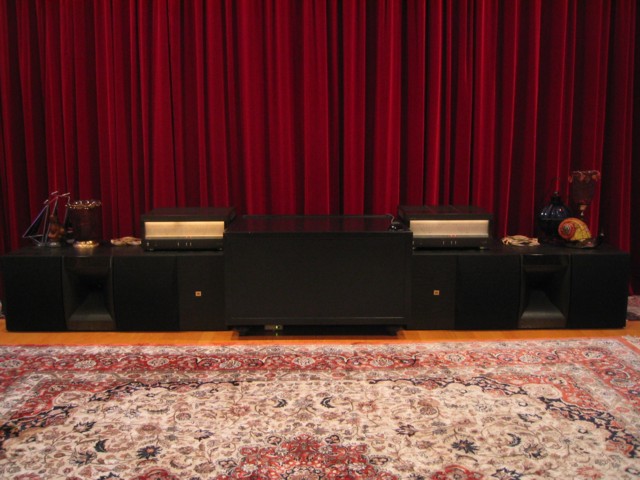
I bought the 1800's new in 1997 at a cost of about $1200 to use as a pair for the single center channel in my surround sound system at the time and I used to have them standing on each side of the projector screen. They sure made a fantastic impact on film material as a center system. Their vast power not to mention range made any other single center channel speaker somewhat of a joke by comparison. Film soundtracks are quite different from music from a CD for example. The speakers need to be able to reproduce quiet delicate uncolored speech to vast explosions from one second to the next. While somewhat brash sounding for CD music, these are my favorite speakers for DVD & Laserdisc film soundtracks. Current Usage
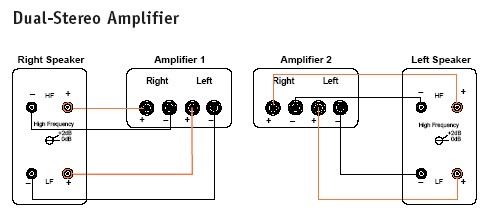
The inputs of the two channels of each Technics SE-A5 power amp are all connected to the single center channel 5.1 output of the Marantz AV-9000 processor. Then the speakers are bi-wired from each channel of each amp as shown below, so the speakers are both bi-wired and bi-ampped.
The SVA-1800's now used as a rear surround pair are mounted on 3 foot high stands at the rear of the room facing sideways towards the listening position. This gets the tweeters at just the right ear level. Of course, such massive speakers were never intended to be used on stands and if you set them up like that at the front of the room in a stereo pair, they look totally over powering! But in the rear corner of the room, they hide away there without too much problem and nobody has ever pointed them out there. The rear speakers are driven by my Onkyo M-504 power amplifier which at 165 watts per channel makes a awesome rear surround system! Photos & Reference
|